


How to tell the 'Shroud of Turin' is a hoax.
For those who have not heard of the Turin Shroud:
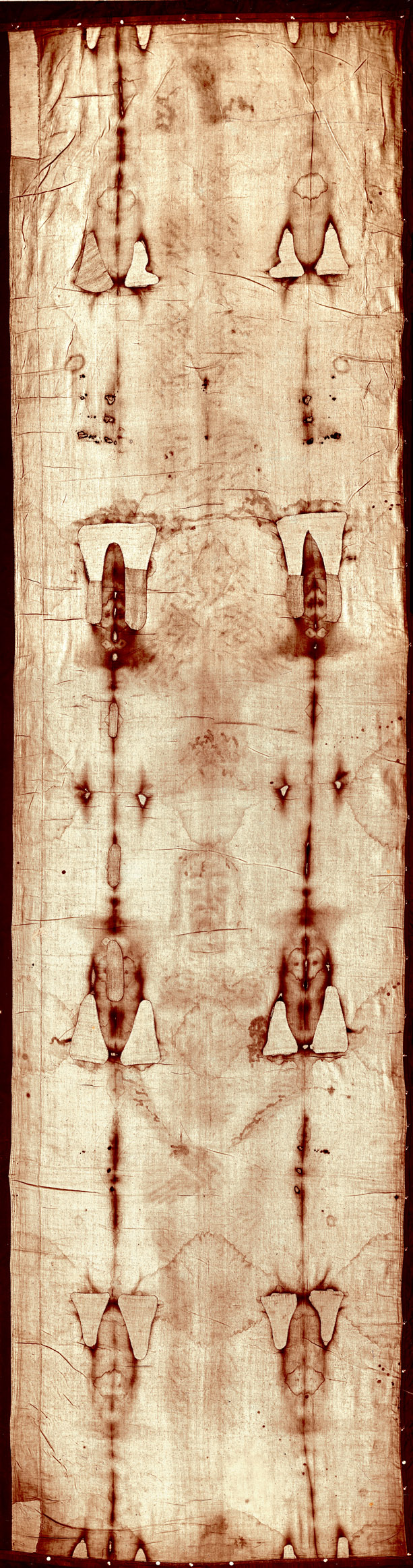
The Shroud of Turin or Turin Shroud (Italian: Sindone di Torino, Sacra Sindone) is a linen cloth bearing the image of a man who appears to have suffered physical trauma in a manner consistent with crucifixion. It is kept in the royal chapel of the Cathedral of Saint John the Baptist in Turin, northern Italy. The image on the shroud is commonly associated with Jesus, his crucifixion and burial. It is much clearer in black-and-white negative than in its natural sepia color. The negative image was first observed in 1898, on the reverse photographic plate of amateur photographer Secondo Pia, who was allowed to photograph it while it was being exhibited in the Turin Cathedral.Leaving aside for the moment any concerns that the 'shroud' might not be that from a 1st century CE Palestinian Jew, there is nothing to prove that that Palestinian Jew in question was the biblical Jesus of course, but we don't need that defence. The 'shroud' is not from the 1st century CE and the image on it was not produced supernaturally by a body wrapped in it.
The historical records for the Shroud of Turin can be separated into two time periods: before 1390 and from 1390 to the present. The period until 1390 is subject to debate and controversy among historians. Prior to the 14th century there are some allegedly congruent but controversial references such as the Pray Codex. It is often mentioned that the first certain historical record dates from 1353 or 1357. However the presence of the Turin Shroud in Lirey, France, is only undoubtedly attested in 1390 when Bishop Pierre d'Arcis wrote a memorandum where he charged that the Shroud was a forgery. The history from the 15th century to the present is well documented. In 1453 Margaret de Charny deeded the Shroud to the House of Savoy. As of the 17th century the shroud has been displayed (e.g. in the chapel built for that purpose by Guarino Guarini) and in the 19th century it was first photographed during a public exhibition.
There are little definite historical records concerning the shroud prior to the 14th century. Although there are numerous reports of Jesus' burial shroud, or an image of his head, of unknown origin, being venerated in various locations before the 14th century, there is little but reliable historical evidence that these refer to the shroud currently at Turin Cathedral.[5] A burial cloth, which some historians maintain was the Shroud, was owned by the Byzantine emperors but disappeared during the Sack of Constantinople in 1204...
The history of the shroud from the 15th century is well recorded. In 1532, the shroud suffered damage from a fire in the chapel where it was stored. A drop of molten silver from the reliquary produced a symmetrically placed mark through the layers of the folded cloth. Poor Clare Nuns attempted to repair this damage with patches. In 1578 the House of Savoy took the shroud to Turin and it has remained at Turin Cathedral ever since.
Repairs were made to the shroud in 1694 by Sebastian Valfrè to improve the repairs of the Poor Clare nuns. Further repairs were made in 1868 by Clotilde of Savoy. The shroud remained the property of the House of Savoy until 1983, when it was given to the Holy See, the rule of the House of Savoy having ended in 1946.
A fire, possibly caused by arson, threatened the shroud on 11 April 1997. In 2002, the Holy See had the shroud restored. The cloth backing and thirty patches were removed, making it possible to photograph and scan the reverse side of the cloth, which had been hidden from view. A ghostly part-image of the body was found on the back of the shroud in 2004. The most recent public exhibition of the Shroud was in 2010.
The simplest way to tell the Turin Shroud is not the image of a body around which is was wrapped is to look at it. However the image is believed to have been transferred to the surface of the linen it could not have happened when it was wrapped around a three-dimensional figure, either by some sort of radiation analogous to light striking a photographic plate, or by direct contact with it, analogous to some sort of contact printing process like lithography or etching. It is a two-dimensional representation of a figure such as is obtained by photography, or as painted by an artist who represents depth with tonal and perspective tricks designed to make the image look three-dimensional.
A cloth wrapped round a three-dimensional object such as a cadaver does not stay flat like a painter's canvas or a photographic plate but folds and puckers to conform to prominences like the nose, hand, shown in the image as resting across the lower abdomen (to modestly hide the genitalia) and feet. To obtain the image seen on the linen the body it was wrapped round would need to be flat.
Don't take my word for this. Try it with any irregular three-dimensional object yourself. Coat it in paint then place it carefully on a white cloth. Fold the cloth around it and tuck the edges under it, as though you are wrapping a body in a shroud. Now unwrap it and see how the paint on the cloth compares to the object you coated. No matter how many times you repeat this and no matter how carefully you do it you will not get a two-dimensional representation of a three-dimensional object. You have exactly the same problem that map-makers have in trying to represent the globe in two dimensions or mountains on a flat surface without resorting to shading or diagrammatic contour lines.
 The effect is similar to the scan of an open book where a three-dimensional object is projected onto a two-dimensional piece of paper. However you try to do it, the image will be distorted. Yet there is no sign of any distortion of what looks like the image of a dead human body.
 A number of studies on the anatomical consistency of the image on the shroud and the nature of the wounds on it have been performed, following the initial study by Yves Delage in 1902. While Delage declared the image anatomically flawless, others have presented arguments to support both authenticity and forgery.Ironically, claims by anatomists that the figure is anatomically perfect are usually quoted by apologists in support of claims of the 'shrouds' authenticity. In fact, they are exactly the opposite; it should not be perfect but should be markedly, and in places, grossly distorted if it is genuine.
In 1950 physician Pierre Barbet wrote a long study called A Doctor at Calvary which was later published as a book. Barbet stated that his experience as a battlefield surgeon during World War I led him to conclude that the image on the shroud was authentic, anatomically correct and consistent with crucifixion.
 There is also another glaring error in the attempt to make the image look like it was wrapped around a real, three-dimensional human body. Look at the junction between the front of the head and the back. There is no sign of a join in the cloth here. In fact, it looks as though the intention was to make it look as though the body was laid face upwards on the bottom end of a long cloth, which was then folded over the head and down to the feet so the cloth was wrapped over the top of the skull.
Try this: put your thumb on the point of your chin and touch your hair-line with your second finger. This gives you the length of your face. Now, keeping your finger and thumb held the same spread, put the tip of your second finger on your hair-line and your thumb on the back of your head. Notice that your head is almost exactly the same size from front to back at your face is long.
 Now look again at the full 'shroud'. Notice the space between the top of the front of the head and the top of the back of the head. Paradoxically, since the cloth would have been in tight contact with the body at this point, this is where we should expect a near-perfect image, not a distorted one. There should be a roughly rectangular image of the top of the head at least as long as the face and the top of the front and back views should curve up into this, not form a neat arch with some sort of stain separating them with a hint of a fold. It should be a bit like looking into one of those distorting mirrors which produce two heads joined at the top. This would be the true representation of the head, projected onto a cloth wrapped around it and then opened out onto a flat, two-dimensional surface.
It is not there!
To me, this simple error destroys any claim to authenticity which the 'shroud' might have had, even for those who believe the myth of Jesus. Any attempt to explain this away or to dismiss it as unimportant can only show an inability to face up to the evidence. It may have been an attempt to depict a shroud as seen from the inside; it may have been some sort of experimental form of art; it is far more likely to have been the work of a clever (but not clever enough) forger cashing in on the insatiable demand for holy relics, but one thing is certain, the image on the 'Shroud of Turin' was not produced by contact with, or by radiation from, a dead body wrapped in it. It is an attempt to represent a front and rear view of a human body in two dimensions, covered with the requisite traditional marks and traces of 'blood' for added authenticity. One is almost tempted to wonder what happened to the original painting from which this was copied, perish the thought.
But then all of this is academic anyway, since the linen cloth was carbon dated and shown, with a 95% confidence, by three independent teams working in Oxford University, England, University of Arizona, USA and the Swiss Federal Institute of Technology to be woven from flax growing between 1290 and 1360, matching exactly the date the cloth makes its first uncontested appearance in a church in France.
The only real objection apologists have managed to mount to this devastating result is to claim that the sample must have been taken from a 13th century 'invisible' repair - a repair which was so good that no one can see where the 'repair' starts and the 'shroud' ends - and that by a fantastic coincidence they happened to hit exactly the wrong tiny fragment when they took the sample for carbon dating - almost as though God didn't want the shroud to be authenticated.
In fact, it's perhaps surprising that no one seems to have come up with the excuse that God caused the true date to be hidden because he doesn't want proof of Jesus. Maybe I just haven't seen it.
Among the more hilarious attempts to prove the shroud's authenticity are:
- A claim to have detected two Roman coins covering the eyes of the figure with enough detail to show them to be a one-lepton coin minted in 29 CE and a two-lepton coin minted 29-30 CE.
- A 2009 claim by Barbara Frale, a paleographer in the Vatican Secret Archives (sic), to be able to read the image of a 'death certificate' written in Greek, Latin and Hebrew which, for some unexplained reason was tucked into the shroud, bearing the words "In the year 16 of the reign of the Emperor Tiberius Jesus the Nazarene, taken down in the early evening after having been condemned to death by a Roman judge because he was found guilty by a Hebrew authority, is hereby sent for burial with the obligation of being consigned to his family only after one full year". This would place it at exactly 31 CE.
| Twitter Tweet | StumbleUpon | Reddit |


0 comments:
Post a Comment