


 |
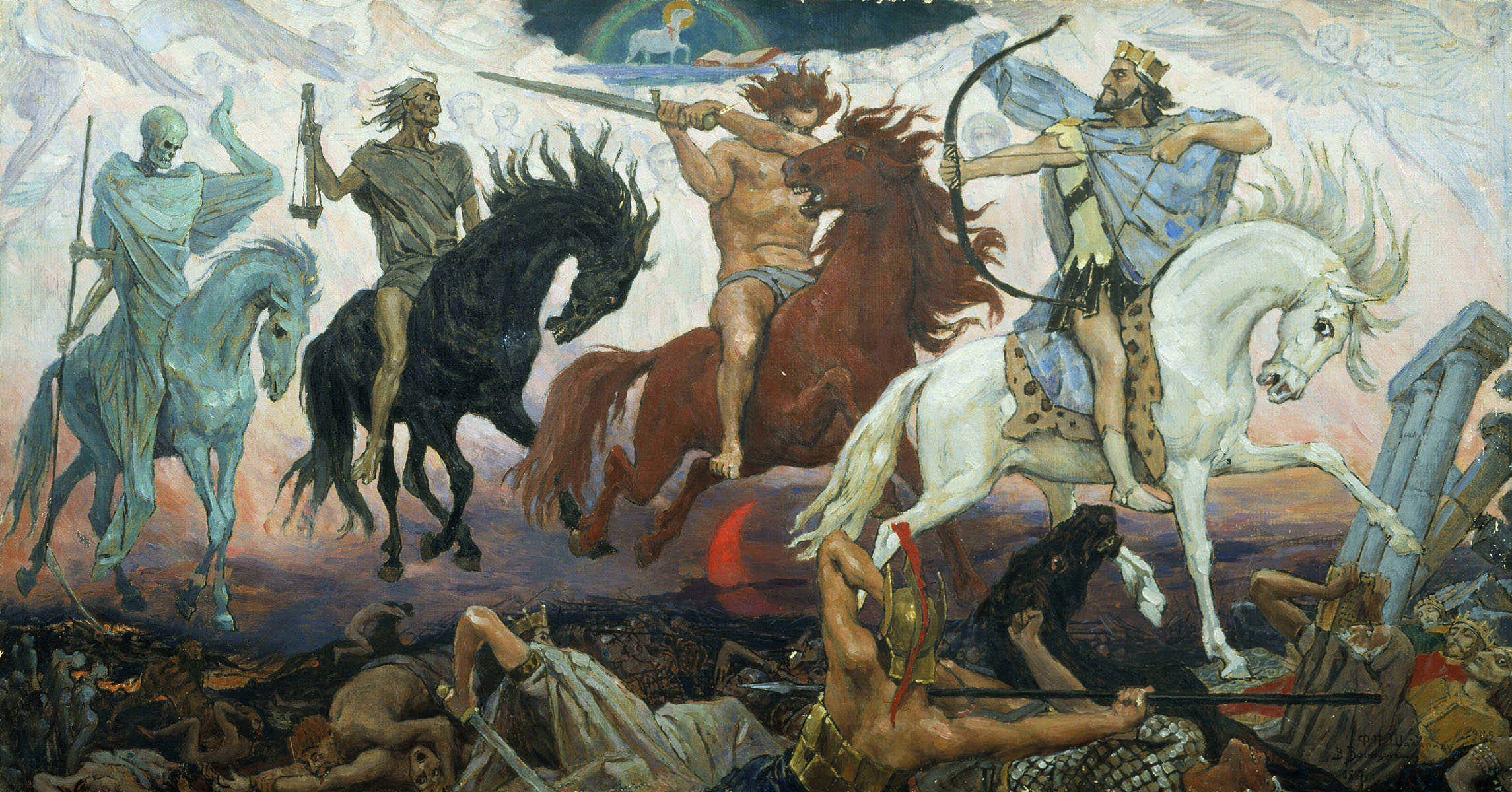
| Four Horsemen of Apocalypse. Viktor Vasnetsov, 1887 |
In earlier blogs I looked at the history of Christian anti-Semitism and how it was a fundamental component of Christian theology almost from the outset, through the Middle Ages and up to the twentieth century, with frequent catastrophic results for European Jewry. (See "Famous Christians - Adolph Hitler", "Famous Christians - Martin Luther" and "More Famous Christians".)
Just in case Jews imagine that the post World War II love and respect American Christians affect to have discovered for them, and the unswerving support they profess for Israel and Zionism, is genuine, it's worth looking at the history of American Christian fundamentalism, how they see the near future and where Israel and the Jews fit in this view.
According to pre-tribulation premillennialists, who are known as dispensationalists, Jesus will come secretly in the clouds and raise deceased Christians – and only Christians – from the dead. Immediately thereafter, every true Christian will be transported bodily into the sky, and from there to heaven: the Rapture event. The passage cited to defend this view is found in Paul’s first letter to the church at Thessolonica:There is no sudden conversion away from anti-Semitism in American fundamentalist Christianity; no sudden discovery of altruism and realisation that the long years of brutal repression and persecution of the Jews that their churches taught and encouraged were wrong. It is just as arrogantly selfish and anti-Semitic as it was in the days of the Christian founding fathers in the first century and the days of Martin Luther in the twelfth.For the Lord himself shall descend from heaven with a shout, with the voice of the archangel, and with the trump of God: and the dead in Christ shall rise first: Then we which are alive and remain shall be caught up [harpazo] together with them in the clouds, to meet the Lord in the air: and so shall we ever be with the LordThroughout most of church history, this passage was associated with the final judgment, but beginning sometime around 1830 in England, it was linked to the premillennial, pretribulational Rapture – a word that is not found in the Greek text or in any English translation of the New Testament. Its Latin root word is in Jerome’s Vulgate, a translation of the Greek "harpazo" – seize, catch, or pluck.
This outlook on the earthly future became increasingly popular among fundamentalists, beginning in the 1870's. It was formalized in the footnotes of the Scofield Reference Bible (1909; revised, 1917). In 1930, it became the first Oxford University Press book to reach sales of one million. It has now sold over five million copies. C. I. Scofield’s system has defined fundamentalism for nine decades.
The Rapture-based escape from history is now universally believed by fundamentalists to be imminent. Generations of fundamentalists have believed that they will escape bodily death. They will be transported into the sky, like Elijah, though without benefit of chariots.
But when? That has been the great question. The answer: "Soon." But why soon? Why not a millennium from now? The psychological answer: Because men do not live that long in this millennium. The main selling point for fundamentalism’s Bible prophecies is to get insight into what is coming soon. In this case, the issue of mortality is central. As the slogan says, "Everybody wants to go to heaven, but nobody wants to die." The doctrine of the imminent Rapture allows Christians to believe seriously that they can go to heaven without dying. Millions of Americans believe this today.
But how can they be so sure? Because of the events of 1948. In that year, the crucial missing piece of the prophetic puzzle – the restoration of the nation of Israel – seemed to come true. Critics of the dispensational system could no longer say, "But where is Israel in all this?" The answer, at long last: "In Palestine, just in time for the Great Tribulation."
The Grim Fate of Israel
The source of the idea of the Great Tribulation is found in Jesus’ last words regarding Israel, which are recorded in Matthew 24 and Luke 21.And when ye shall see Jerusalem compassed with armies, then know that the desolation thereof is nigh. Then let them which are in Judaea flee to the mountains; and let them which are in the midst of it depart out; and let not them that are in the countries enter thereinto. For these be the days of vengeance, that all things which are written may be fulfilled. But woe unto them that are with child, and to them that give suck, in those days! for there shall be great distress in the land, and wrath upon this people. And they shall fall by the edge of the sword, and shall be led away captive into all nations: and Jerusalem shall be trodden down of the Gentiles, until the times of the Gentiles be fulfilled.Throughout most of church history, this prophecy was interpreted as having been fulfilled by the Roman siege of Jerusalem and the destruction of the temple in 70 A.D. With the rise of dispensationalism, however, the fulfilment of this passage was moved into the future.
Dispensationalism’s critics had long asked: "Where is the nation of Israel? Where are the Jews?" Not in Palestine, surely. So, dispensationalists tended to apply this prophecy of near-destruction to Jews in general – only symbolically residing in Israel – until 1948. This was one reason for their silence on Hitler’s persecution. Hitler was just another rung in the ladder of persecution leading to the inevitable Great Tribulation.
The prophesied agency of the great persecution has shifted over the years. As Wilson shows in Armageddon Now!, from 1917 until 1977, Russia was a prime candidate. But, after 1991, this has become difficult to defend, for obvious reasons. The collapse of the Soviet Union has created a major problem for dispensationalism’s theologians and its popular authors. But there have been no comparable doubts about the intensity of the coming persecution. Here is the opinion of John F. Walvoord, one of dispensationalism’s leading theologians, who served for three decades as the president of Dallas Theological Seminary (founded, 1924), the movement’s main seminary.
The purge of Israel in their time of trouble is described by Zechariah in these words:And it shall come to pass, that in all the land, saith Jehovah, two parts therein shall be cut off and die; but the third shall be left therein. And I will bring the third part into the fire, and will refine them as silver is refined, and will try them as gold is tried.According to Zechariah’s prophecy, two thirds of the children of Israel in the land will perish, but the one third that are left will be refined and be awaiting the deliverance of God at the second coming of Christ which is described in the next chapter of Zechariah. [John F. Walvoord, Israel in Prophecy (Grand Rapids, MI: Zondervan, [1962] 1988), p. 108.
Nothing can or will be done by Christians to save Israel’s Jews from this disaster, for all of the Christians will have been removed from this world three and a half years prior to the beginning of this 42-month period of tribulation. (The total period of seven years is interpreted as the fulfillment of the seventieth week of Daniel [Daniel 9:27].)
In order for most of today’s Christians to escape physical death, two-thirds of the Jews in Israel must perish, soon. [My emphasis] This is the grim prophetic trade-off that fundamentalists rarely discuss publicly, but which is the central motivation in the movement’s support for Israel. It should be clear why they believe that Israel must be defended at all costs by the West. If Israel were militarily removed from history prior to the Rapture, then the strongest case for Christians’ imminent escape from death would have to be abandoned. This would mean the indefinite delay of the Rapture. The fundamentalist movement thrives on the doctrine of the imminent Rapture, not the indefinitely postponed Rapture.
Every time you hear the phrase, "Jesus is coming back soon," you should mentally add, "and two-thirds of the Jews of Israel will be dead in ‘soon plus 84 months.’" Fundamentalists really do believe that they probably will not die physically, but to secure this faith prophetically, they must defend the doctrine of an inevitable holocaust. [My emphasis]
This specific motivation for the support of Israel is never preached from any fundamentalist pulpit. The faithful hear sermons – many, many sermons – on the pretribulation Rapture. On other occasions, they hear sermons on the Great Tribulation. But they do not hear the two themes put together: "We can avoid death, but only because two-thirds of the Jews of Israel will inevitably die in a future holocaust. [My emphasis] America must therefore support the nation of Israel in order to keep the Israelis alive until after the Rapture." Fundamentalist ministers expect their congregations to put two and two together on their own. It would be politically incorrect to add up these figures in public.
The fundamentalists I have known generally say they appreciate Jews. They think Israel is far superior to Arab nations. They believe in a pro-Israel foreign policy as supportive of democracy and America’s interests. They do not dwell upon the prophetic fate of Israel’s Jews except insofar as they want to transfer the threat of the Great Tribulation away from themselves and their families. Nevertheless, this is the bottom line: the prophetic scapegoating of Israel. This scapegoat, not Christians, must be sent into the post-Rapture wilderness.
In the deluded minds of fundamentalist Christians, the Jews of Israel are being set up as sacrificial scapegoats. American Christians support the state of Israel and the right of Zionist Jews to live there because they want Jews to die horribly in some imaginary imminent 'Apocalypse' so that biblical prophesy can be fulfilled and they can have the whole world for themselves.
No, it doesn't make any sense to a rational, educated person, but to the deluded minds of people inculcated in the Christian fundamentalism to be found in parts of the USA it does. With the parochial cultural arrogance, and abysmal scientific knowledge barely better than that of a first century theologians which normally accompanies it, this perverse and perverted, infantile view of a magical world of spirits and gods with human emotions and an obsessive preoccupation with this insignificant fragment of the universe and with them in particular, it makes perfect sense.
And these nutters have nukes.
Just feel that Christian love!
Further reading:
What does Rapture Theology Say About Christians?
The Power of The Story.
| Twitter Tweet | StumbleUpon | Reddit |


0 comments:
Post a Comment