


 It's obvious from watching the daily interchanges between Christians and non-believers in social media like Twitter and Reddit that there are several question which any but the most stupid Christians simply will not answer, not even to say they don't know the answer.
It seems what they crave more than anything is certainty. Anything, even thinking of how to answer some questions, will not be permitted if it would introduce the slightest uncertainty. Either that, or they know the question exposes an invalid assumption, even a lie, in their faith.
The closer you get to the heart of their 'faith' the more defensive they become and the less likely you are to get an honest answer without having to wade through torrents of prevarication and diversionary tactics, often descending into abuse, condescension, indignation and accusations of persecution, or excuses to break off the conversation and offers to "agree to disagree".
- Why is 'nothing' assumed to be the default state of existence?
This underpins the KCA and yet there appears to be no logic behind the assumption. If anything, the assumption is completely devoid of logic. What possible logical argument can be made to arrive at the conclusion that 'nothing' can exist? The idea is logically absurd.
But even if you can somehow show that 'nothing' has any logical meaning in terms of existence, how can you then determine any of its characteristics, such as what can come from it?
And yet religious apologists glibly trot out the article of faith that 'you can't get something from nothing' or 'nothing can come from nothing', then promptly abandon that argument by declaring that something can come from nothing but only if their god made of nothing and which came from nothing says the right magic spells.
It's not hard to understand why Christians won't answer this one. What's hard to understand is why they persist in using an argument which they know is so flawed they are embarrassed by it and yet claim to be doing it in defence of a god of truth. - What is your god made of if nothing existed before it created everything?
If you get any response to this it won't ever answer the question; it will simply assert that the god in question is eternal and exists outside space and time. This of course intentionally side-steps the question completely. Yet the same faith insists that the only logical explanation for the existence of anything is that it must have been caused, "because everything that begins to exist must have a cause". Behind this claim lies an assumption that there is a set of things which don't begin to exist and yet the faithful can never say how they determined what should be in that set and why it should be restricted to only their favourite god.
Obviously those who rely on this, the KCA, realise they are trying to get away with invalid assumptions that:- Everything must have begun to exist.
- Therefore, everything needs a cause.
- My god is exempt from this but nothing else is, but somehow this doesn't invalidate assumptions a & b.
- There is no inconsistency in applying my 'logic' to your argument but declaring my argument exempt from it.
And even if you manage to wade through that, you'll be no closer to knowing what the god being promoted is made from, even though it must be more complex that the universe it is claimed to have created to contain enough information to create it and keep it all under control, even before it starts monitoring your thoughts, listening to the constant babble of prayers and deciding which deserve to be answered, keeping a check on your sex life and whether you touch your genitalia and enjoy it, or if you are responsible for a man becoming sexually aroused because he caught a glimpse of your face, breasts or bottom. - If complexity must be intelligently designed, who or what intelligently designed your god's complexity?
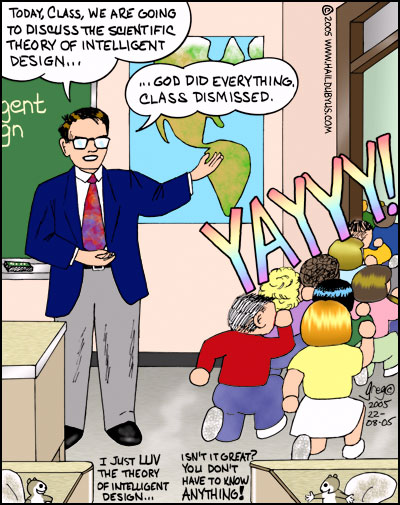
This is the 'Teleological Argument' or 'Argument From Design' which, so far as biological systems are concerned, was refuted comprehensively by Darwin and Wallace in 1859. It can also be refuted by simple logical deduction.
In order to have the knowledge and understanding to create a universe and all living species on earth, a perfect creator must necessarily be more complex than the universe it creates. In order to monitor and observe it, and thereby exercise some control over it, it must be able to hold a perfect conceptual model of the universe to be able to see and plan change. This model must include the god itself in the model, complete with a model of itself, ad infinitum, otherwise there will be a point at which its knowledge is imperfect.
This means the creator must be infinitely complex. So, if complexity needs a creator, there must be another infinitely more complex creator, and another infinitely more complex than that one.... and so ad infinitum. An infinity of increasingly more complex infinitely complex creators and requiring a concept of larger and smaller infinities.
This is probably as close as you can come to a position so logically absurd as to not warrant even considering, so rendering the entire 'complexity must be designed' argument absurd. Like the KCA, an example of a theological argument which its proponents need immediately to try to abandon to try to make it work. A form of special pleading so common in theology where their small god has to be granted special privilege to compete with the big boys of science and normal grown up logic.
A veritable triumph of theological argument that! It results in the god being defended and promoted as infinitely wise and powerful, being reduced to an inadequate little god which needs affirmative action to compete on an equal footing with science and maths, and for the humans it allegedly created being required not to use the intelligence it allegedly endowed them with for anything other than making excuses for its inadequacies. Its followers claim it created us to worship it and wonder at it's power and majesty, yet they insist we treat it like a handicapped child - which of course, being unintelligently designed by inadequate people, it very probably would be - if it were real.
So, as with the KCA, it's not hard to understand why Christians won't answer the question but not why they use an argument they know to be false to defend a god they claim is a god of truth and honesty from whom they get their 'good' morals. - Assuming you are right and the only way to explain everything is to invoke a supernatural explanation, how did you conclude that your god was the only possible supernatural one which could do it?
There will of course never be an answer to this question because any Christian with an IQ higher than a plank will know there is no way to answer it. There is no way to investigate the supernatural to determine the range of possibilities and to eliminate all the others bar one. Nor is it possible to make any comparisons between all the different possible supernatural explanations.
You will get a response of sorts, though. You will get an assertion that theirs is the only god, so no others need be considered but they will never explain why other than with a passage from a book they have learned to chant when faced with that cognitive dissonance, rather like a protective mantra. They will never explain why the logic by which they conclude that all other hypothetical gods are false should not apply to their god.
The reason they won't answer this question is, again, because the answer is frankly embarrassing. It's almost invariably because they've learned to avoid the question and so have never really thought about it, preferring to just assume that someone else must have done the work at some point and that's why their family and so many other people in their culture believe it.
In effect, they are too embarrassed to admit they've just taken someone else's word for it and can't now admit they could be wrong. It's our old friends, intellectual indolence and ignorant parochial arrogance to the rescue. - If you get your knowledge of right and wrong from the Bible, how can you tell it wasn't written by Satan?
This question often evokes an abusive response but never an answer. I have been asking it repeatedly on Twitter, and in a blog, How Do You Know Satan Didn't Write The Bible?, for over a year now. In that time the blog has had 13937 hits at the time of writing. No one has yet given a coherent answer.
Of course, this strikes at the heart of a central tenet of Christian faith - that there are no objective morals without a god to hand them down (and that therefore Christians are morally superior since they have the one true god therefore the one true moral code).
And yet they are unable to resolve the paradox of therefore not knowing if their faith (and the morals that come with it) is the work of an evil being intending to deceive, or those of a good being wishing them well.
In actual fact, of course, almost without exception, Christians will have worked out ways to explain away the obviously wrong things commanded by their god in the Bible and to take only the good stuff, such as it is. Clearly, they are applying an external standard of morality when they now reject the endorsement of slavery, selling daughters, forcing a rape victim to marry the rapist and, increasingly, the inferior position of women in the Bible. The reason Christians, on the whole, don't any longer behave like the god of the Bible is because they now know better.
So, to answer this question honestly would necessitate them admitting that the Bible is not the word of a perfect, and perfectly moral, god, from which their claim to power and authority is derived. Rather than give up that they would rather abandon intellectual honesty and personal integrity, yet, in doing so, they reveal to the rest of the world that their 'faith' is being used as an excuse for something they are not owning up to, probably understandably so. - If your god has always known all your decisions since before it created you, can you make different ones?
Stated more simply, this question could be, "If your god knows what you will have for breakfast tomorrow, can you choose something else instead?"
Like the previous question, I have been asking it for well over a year on Twitter in one form or another and on a blog, On Omniscience And Freewill, for over two years, and have still to receive a sensible answer. The few attempts to answer it have invariably been muddled and contradictory, arguing that there is some way in which a god can not know your actual choices yet still know what you would choose, or that omniscience merely means knowing the entire range of possible choices. Even one attempt to argue that the god can choose to forget what it knows so it both knows and doesn't know simultaneously.
Of course the simple logic is that if you can surprise a god, that god isn't omniscient, and if you can't surprise that god, you don't have free will.
The reason most 'sensible' Christians refuse to answer this question is because it destroys the very foundation of their religion - the notion of original sin and the need for redemption through Jesus. If man doesn't have freewill then everything is pre-ordained and there was no original sin, merely the fulfilment of predestination. The notion of an omniscient god also renders that god powerless, constrained by it's own inerrant knowledge of the future. If there is freewill then the Christian god isn't omniscient and so has no moral authority by which to judge us.
Refusal to contemplate this paradox at the heart of their faith shows us that Christians are only too aware that their 'faith' is based on a lie. From that simple observation we can conclude that the Christian 'faith' is not something they actually believe to be true but something which has a mere utility value; an excuse and something to threaten and control others with. - What is the purpose of prayer?
You would think that, since they spend so much time allegedly praying, Christians would be able to answer this question easily and succinctly, but not a bit of it. I have been asking this on Twitter and in a blog, Can Someone Explain The Purpose Of Prayer, Please? for about nine months, and no coherent answers.
The problem is with the Christian god's alleged omniscience, omni-benevolence and inerrancy. If it already knows what's happening, then the purpose of prayer can't be to inform it. If it is omni-benevolent then it will have already ensured that that which does the most good is being done. There is no point in asking it to stop something undesirable from happening or to make something desirable happen, because it will always have been aware of these things and will have prevented them if they are not in the prayer's interest. It will already be aware of any declarations of adoration or gratitude and it will be aware of any insincerity, so the purpose of prayer can't be to fool it.
None of this is hard to work out so most Christians will be aware of it - which is why they won't ever answer the question honestly. Clearly, they either know the real purpose of prayer has nothing to do with its stated function, or they don't believe their god is omniscience and or omni-benevolent.
In fact, it looks for all the world as though it is fear of their god which is driving them and prayer is an attempt to mollify and pacify it, like the actions of pagans in trying to pacify a volcano or earthquake god. Not surprisingly, none of them are going to own up to that.



 |
| Praying Hands Albrecht Dürer (1471-1528) |
A formative influence on my undergraduate self was the response of a respected elder statesmen of the Oxford Zoology Department when an American visitor had just publicly disproved his favourite theory. The old man strode to the front of the lecture hall, shook the American warmly by the hand and declared in ringing, emotional tones: “My dear fellow, I wish to thank you. I have been wrong these fifteen years.” And we clapped our hands red.
Just a few very simple questions and yet they provoke the most extraordinary response in Christians. To be fair, it's not just Christians who panic at these or similar questions. Muslims are also especially prone to it and readily resort to abuse and threatened or actual violence rather than answer them.Richard Dawkins, 1996
It's quite astounding how the need to handle uncomfortable cognitive dissonance can provoke such a spectacular and revealing response in religious people. Imagine a scientist being confronted with simple questions which show his theory to be wrong. The sensible thing to do would be to thank his questioner for correcting his error and to change or abandon his theory. To do anything else would earn the justified opprobrium of his colleagues and reduce his standing immeasurably in the scientific community.
Christians, on the other hand, gain kudos for their creativity and skill at avoiding the embarrassing questions and finding ways to blame the questioner. Christian apologists earn their living inventing new ways to avoid the obvious and wave it aside.
| Twitter Tweet | StumbleUpon | Reddit |


0 comments:
Post a Comment